“Nonintervention does not mean that nothing happens. It means that something else happens.” – Christopher Hitchens
Last week brought the news of a fresh schism in the Catholic Church, with the Vatican excommunicating an ultraconservative sect of bishops and warning their followers to return to the mainstream of the church or be similarly cut off from Rome. We are less formal about excommunication in the wine world, but we certainly have our sects. “Natural wine” (to reduce monotony, this is the only time the term will appear in its deserved quotation marks) is a term sometimes claimed by winemakers and sometimes applied to them by others. It has been affixed to bars, retail stores, wine clubs, wine fairs, and wine books. No corner of the wine world has gone untouched. How should we think about natural wine? How should collectors navigate its many and tortuous definitions? Should they even care? All this and more below.
Trees, Timber, and Particle Board
The French use a curious word, élevage, to describe aging wine before release. “Raising”, “bringing up”, or even “breeding”, this term suggests an intimate, pastoral relationship between winemaker and wine. The word also illustrates wine’s elevated status among its fellow commodities. We brew beer, we distill spirits, we raise wine. With this kind of attitude, it’s little wonder that ideas about moral superiority grow up around winemaking like suckers from a vine’s base.
Grapes give us wine just as trees give us shelter, which is to say: very crudely. Shelter can be found under the eaves of the forest, but humans long ago desired more custom-made eaves, and found trees to be useful in forms other than their natural one. Similarly, grapes will ferment into an alcoholic beverage with very little input from humans. No input, one might argue – technically true, though I have yet to see anyone market experiential puddle-wine drinking under wild vines. Given the wild vine’s preference for green growth over fruitfulness, this would be a challenging business proposition even if the demand were proven (laugh if you will – I have tasted “non-interventionist” wines that gave more than a glimpse into this sort of experience). Indeed, vineyards are inherently interventionist endeavors, training vines into shapes they would never naturally assume and coaxing them into a level of fruitfulness unheard of in the wild.
While well-cut timber is preferable to trees when it comes to carpentry, we do make a distinction between hardwood furniture and particle board furniture. To extend the metaphor, there are some interventions in the vineyard that make our raw materials more commercially exploitable but reduce their quality. For the reduction of these practices – complete under-row defoliation, blanket synthetic pesticide application and its attendant destruction of biodiversity, irresponsible water use and gross overcropping, among many others – we partly have the natural wine movement to thank. So what’s the problem?
Product and Process
The central issue of the natural wine debate is almost never talked about. Arguments about the relative merits of positive methods (positive in the sense that they are actions performed, rather than actions avoided – organics, biodynamics, regenerative agriculture, etc.) or the evils of negative ones (sulfur dioxide is a favorite scapegoat) are all secondary. The issue that separates winemakers who adhere to more natural methods from upper-case-N Natural Winemakers is the primacy of either product or process.
Adherents will claim that natural winemaking is simply a return to ancient practices, but it also has a modern historical context. Whether one credits the Beaujolais “Gang of Four” (a marketing term coined by US importer Kermit Lynch for Marcel Lapierre, Jean Foillard, Jean-Paul Thévenet, and Guy Breton to sell more Beaujolais), or their inspiration, Jules Chauvet, with the origins of the movement, the initial impetus was against bad wine. Hatred of industrial-scale Beaujolais Nouveau drove changes in the vineyard and the winery. The “Gang” craved better wine – more distinctive, more complex, more delicious.
Somewhere along the way, the subtle difference between “I’m changing the way I approach x in the vineyard because I’ve found it makes my wine taste better” and “My wine is better because I do x in the vineyard” was lost. The former preserves the supremacy of product while the latter leaves an open door for bad incentives to elevate process to the top of the hierarchy. Before long, it was “Of course you should like the way this wine tastes – it’s made authentically using x” instead of “Hey, this wine tastes kind of off – maybe we should rethink x.”
The Moral Value of Taste
Readers may rightly protest, “But who gets to decide which tastes are good and bad?” This is art’s age-old question, and I will not attempt an answer here. My argument is not to label the flavors of natural wine “bad” (to the extent the category even has a consistent set of flavors, or even qualifies as a defined category), but to return to the supremacy of taste. A wine is good because it tastes good to the drinker, and the practices in the vineyard and winery that made it taste that way are of interest exactly to that extent: how they made the wine tasty.
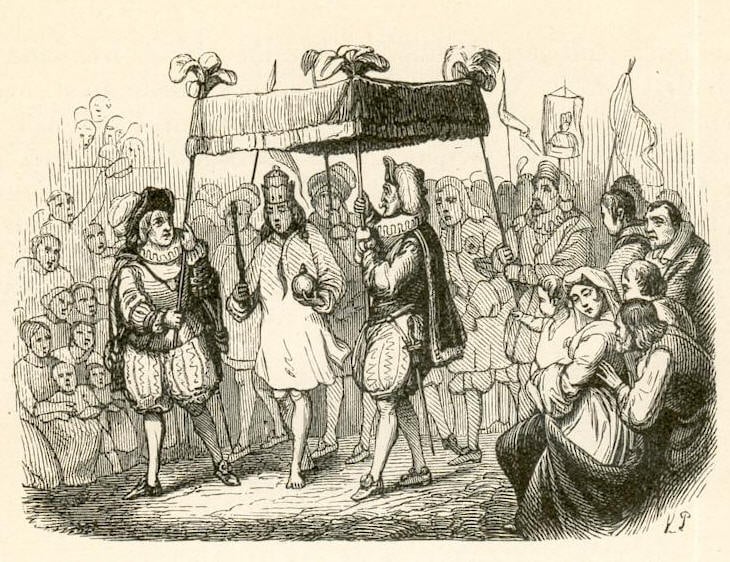
The swindle in Hans Christian Andersen’s classic “The Emperor’s New Clothes” is so successful because it weaponizes the inherent emptiness of popular hype. “Cool” has no substance, but its immense cultural power can make something – even if that something is nothing, as in the story – into a shared delusion. The inflection point comes from a child watching the emperor parade around in the buff: “But he hasn’t got anything on!”
This is the essential quality of taste, and the only sense in which it has what might be called “moral value” – if its independence is maintained, it can break the spell of shared delusion. The crowd begins to take up the cry. “But he hasn’t got anything on!” The emperor pushes on with head held high, but the illusion has vanished.
Next time you hear someone droning on about the biodynamic preparations or about how they have performed an exorcism on their winery to ensure all traces of the sulfur dioxide demon have fled (okay, I’ve never heard of anyone doing this, but at this point it wouldn’t surprise me), hold up your finger and ask them to kindly shut it. Then taste the wine in front of you. Is it delicious? Maybe ask a question about how the winemaker was able to achieve that kind of magic. Not delicious? Dump it down the drain and move on.
The End of an Era
“Zero-zero” is the credo of the natural wine movement’s most devout followers: nothing added, nothing taken away. The most talked-about “nothing” is sulfur dioxide, wine’s most important preservative against oxidation and bacterial growth (SO2 has less effect on yeasts, and it will not prevent refermentation in bottle if residual sugar and viable yeast cells remain). France’s Vin Méthode Nature designation, formally recognized in 2020, gives a separate, more prestigious badge to those who both add no sulfur and whose wines test under 20 mg/L for naturally occurring SO2. Even if they test under the same limit, those who add sulfur must use the less prestigious “< 30 mg/L de sulfites” version of the badge on their bottles. But with more than four decades of modern natural wine out there to evaluate, even some of the most vocal “zero-zero” proponents have begun to rethink their allegiance.
Frank Cornelissen spent two decades making no-sulfur-added wines on the slopes of Sicily’s Mount Etna, but eventually began adding small amounts of sulfur after revisiting his own earlier wines in bottle. The inconsistency of the more difficult vintages convinced him to begin trials with small amounts of added sulfur. After a few vintages, he concluded that his wines were more consistently representative of the terroir with the sulfur than without it. That news should have made waves in the natural wine world, but it was more like ripples. Consumer demand for natural wines has continued to expand through secondary and tertiary markets, even while the pendulum seems to have begun swinging back the other way in major markets like New York. Eventually, growth in those newer markets will come to an end, and the demand for natural wine will begin to wane.
When a natural wine poster child like Cornelissen is having second thoughts, collectors should take a hard look at any no-sulfur-added producers they are adding to their cellars. In five, ten, or twenty years, the Instagram hype will have worn off, and the juice in the bottle may not deliver the promised epicurean return. Even if a few bottles per case survive, is it worth playing wine fault roulette?
So Long, and Thanks for All the Fish
Douglas Adams’s dolphins knew just when to cash in their chips, and so should we. The natural wine movement really has given us a lot of fish, mostly in the form of increased consumer interest in responsible farming and additive reduction that has caused even industrial-scale wine producers to shift toward better practices. But that progress doesn’t have to come at the cost of tastiness. It really is possible to have both, but not until we begin behaving more like the little boy in the crowd and pointing our fingers at wines that are putting process above product.