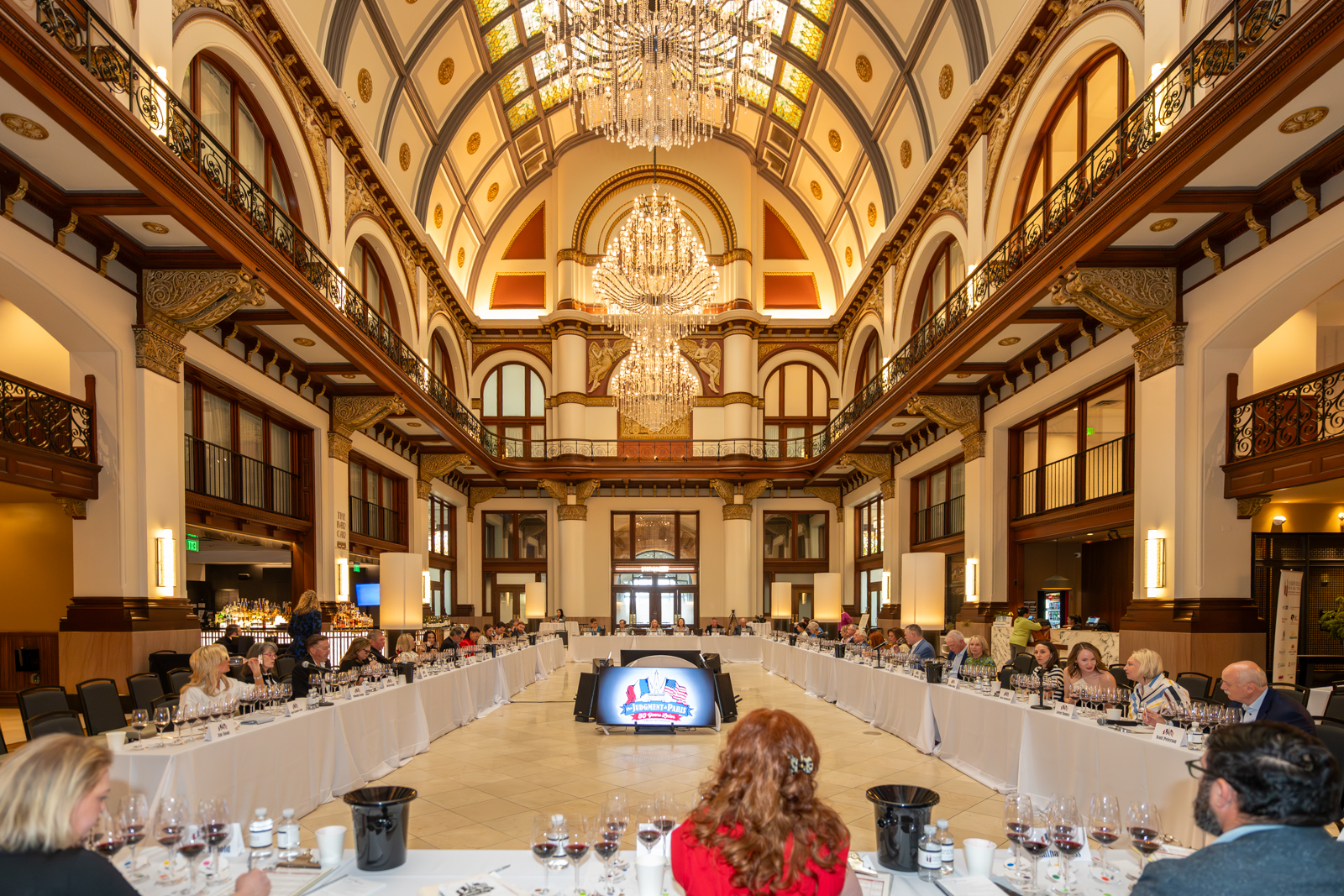
Do the pioneers of Northern California still hold up to the icons of France after 50 years? The 50th anniversary of Steven Spurrier’s Californian wine tasting on French soil has spawned countless reenactments, reassessments, and recriminations, but few have attempted what the Nashville Wine Auction and famed wine author Karen MacNeil organized a few weeks ago under the towering ceiling of Nashville’s Union Station Hotel. The original wines of what became known as “The Judgment of Paris” were once again tasted blind, this time by an eager audience as well as a panel of professional tasters, on which I was honored to sit.
The format was simple: 19 of the original 20 wines (Veedercrest Chardonnay is no longer produced) were assembled, not from the original vintage, but the vintage 50 years later. 1970 Haut-Brion became 2020 Haut-Brion. 1973 Stag’s Leap became 2023 Stag’s Leap, presumably mirroring the maturity at which the wines were tasted by the original panel of France’s best. Each wine was scored out of 20 possible points, and the points tallied together for a composite score, in a faithful recreation of the original tasting. Two other anomalies should be noted: Heitz didn’t produce a 2020 Martha’s Vineyard due to California’s wildfires that year (the 2019 vintage was substituted), and Spring Mountain Vineyard submitted a 2024 Heintz Vineyard Chardonnay instead of the 2023 Chardonnay that would have more correctly aligned with the original 1973 Chardonnay.
In addition to the distinct pleasure of tasting through the wines, some of which have become nearly unobtainable in the intervening half century, three things struck me about the results of the tasting: the differences from the 1976 results, the taste differences between the professional panel and the audience, and which wines would be chosen today to rival the French classics if the tasting were being put together for the first time.
How (Half) the Mighty Have Fallen
First, I’ll focus on the results of the professional panel in the spirit of the original tasting. The two overall victors in 1976, Chateau Montelena Chardonnay and Stag’s Leap Wine Cellars Cabernet Sauvignon, had opposite fates in the eyes of the judges this time around. Montelena’s Chardonnay was bumped down only a single peg, finishing at #2. Stag’s Leap, however, tumbled down the list to finish eighth out of ten entrants. It’s hard to blame the change on the vintage. 2023 was a benchmark year in northern California by all accounts, with some critics even hazarding it as the 21st century’s best so far.
Montelena was unhorsed by Domaine Leflaive’s 2022 Puligny-Montrachet 1er Cru Les Pucelles (up from its disastrous #8 finish in 1976) – hardly an embarrassment, as the Leflaive trades for nearly ten times the price. Perhaps more impressive is the fact that Montelena still scored higher than 2023 Ramonet Bâtard-Montrachet (#4) and 2023 Roulot Meursault 1er Cru Charmes (#5), both of which command even higher prices than the Leflaive. Spring Mountain’s 2024 Heintz nabbed the #3 spot, up from its #4 finish in the original tasting (up for debate, perhaps, as neither the vintage nor vineyard matched the original entrant). The clean, almost Chablis-like clarity of the Spring Mountain proved that overt oak was not the only path to victory.
Mouton Rothschild’s 2020 effort was the overwhelming #1 in the red category, sweeping both the professional and audience scorecards, up from its #2 finish in 1976. The professional panel gave it a composite score a full 15 points above the next-highest wine, the largest gap among the reds. 2021 Ridge Monte Bello came in second, up from #5 in 1976 – little surprise, as the 30th-anniversary tasting organized by Spurrier on both sides of the Atlantic declared it the overall victor. 2020 Haut-Brion reclaimed its #3 spot and #4 went to current sommelier darling Mayacamas, up from #7. Freemark Abbey improved admirably (from #10 to a two-way tie for #5) and Montrose suffered a precipitous fall to #7, likely due to an outsized Brettanomyces influence in the 2020 bottling.
Steven Spurrier chose French wines that he thought would easily sweep the Californian offerings. Nonetheless, in 1976 three of the top four Chardonnay spots were awarded to Californians. France did rather better in the reds, where three of the top four wines hailed from Bordeaux. The grouping at the top changed only slightly this time around, with two French and two Californian wines in each category – an indication, perhaps, that the playing field is more even now than it was five decades ago, with the most ambitious producers winning regardless of region.
Power to the People
No scorecards were given to the tiny audience in 1976, but the attendees of this reenactment scored the wines blind along with the professional judges. Their composite scores tended to vary sharply from the professional ones, with the exception of the universally adored Mouton.
Riper, richer styles of Chardonnay fared much better with the audience, favoring California heavily. Chalone’s 2024 Estate Vineyard Chardonnay claimed the #1 spot, nearly the least expensive wine in the lineup (only Freemark Abbey’s 2022 trades lower). The two most expensive wines, Ramonet and Roulot, languished near the bottom of the audience’s scorecards, #7 and #8, respectively. The best result from across the pond was by far the least reductive and most opulent, Drouhin’s 2023 Beaune 1er Cru Clos des Mouches Blanc, which came in second. The one Californian wine on which the audience and professionals agreed was the Spring Mountain, which was awarded the #3 spot in both cases.
The most striking difference in the audience’s red wine scores was undoubtedly the 2023 Stag’s Leap S.L.V., which notched a #2 finish, a far cry from the professionals’ #8. California wowed the audience in the red category overall, with five of the top six spots, two of which (Ridge and Mayacamas) the professionals also loved, and two of which (SLV and Clos du Val) the professionals panned. The most expensive Californian wine, however, fared poorly with audience and professionals alike: Heitz’s legendary and oft-divisive Martha’s Vineyard, which came in last place for both groups.
The overall message from the audience seems clear: a preference for ripeness and approachable fruit, combined with a distaste for reduction and Brettanomyces. “Give the people what they want” seems to be the operative adage here, with the caveat that when Bordeaux gets everything undeniably right (as in the case of the 2020 Mouton), it can win out over sunny northern California.
The Times They Are A-Changing
Despite their success with the audience, I couldn’t help noticing how strange the Californian lineups looked in modern context. A few names still carry weight, to be sure: Ridge, Mayacamas, Montelena, Heitz. But many of the ragtag disruptors Spurrier selected in 1976 have become the corporate old guard of today. True, hedge fund ownership doesn’t seem to have disagreed with Spring Mountain, but others haven’t fared so well, and their scores with the professional panel seem to correlate inversely with their more widespread commercialization. Bordeaux, you may protest, is no stranger to insurance conglomerates and hedge funds, which is true, but it seems like the stylistic pressures the market applies to first growth Bordeaux are different than those applied to, say, California Chardonnay.
What wines would be selected to compete in a Judgment of Paris imagined for the first time in 2026? I can’t help feeling that the French producers look nearly correct and the domestic ones need some updating. It’s an illuminating exercise to put together a list of your own. Here’s mine, evened out to five entrants from each country rather than Spurrier’s generous 4 vs. 6:
A Modern Judgment of Paris: excluding vintage and listed in alphabetical order with the French wines first
Chardonnay:
Pierre-Yves Colin-Morey Corton-Charlemagne Grand Cru
Hubert Lamy Saint-Aubin 1er Cru En Remilly
Domaine Leflaive Puligny-Montrachet 1er Cru Les Pucelles
Domaine Jean-Claude Ramonet Bâtard-Montrachet Grand Cru
Domaine Roulot Meursault 1er Cru Charmes
Ceritas Peter Martin Ray Vineyard Chardonnay
Kistler Dutton Ranch Chardonnay
Kongsgaard The Judge Chardonnay
Littorai Heintz Vineyard Chardonnay
Chateau Montelena Chardonnay
Cabernet Sauvignon / Bordeaux Blends:
Corison Kronos Vineyard Cabernet Sauvignon
Mayacamas Vineyards Cabernet Sauvignon
Who would win a modern version of the Judgment of Paris? Which wines would you include from the original tasting? Which new challengers are most deserving of a chance at glory? Drop us a line to let us know.