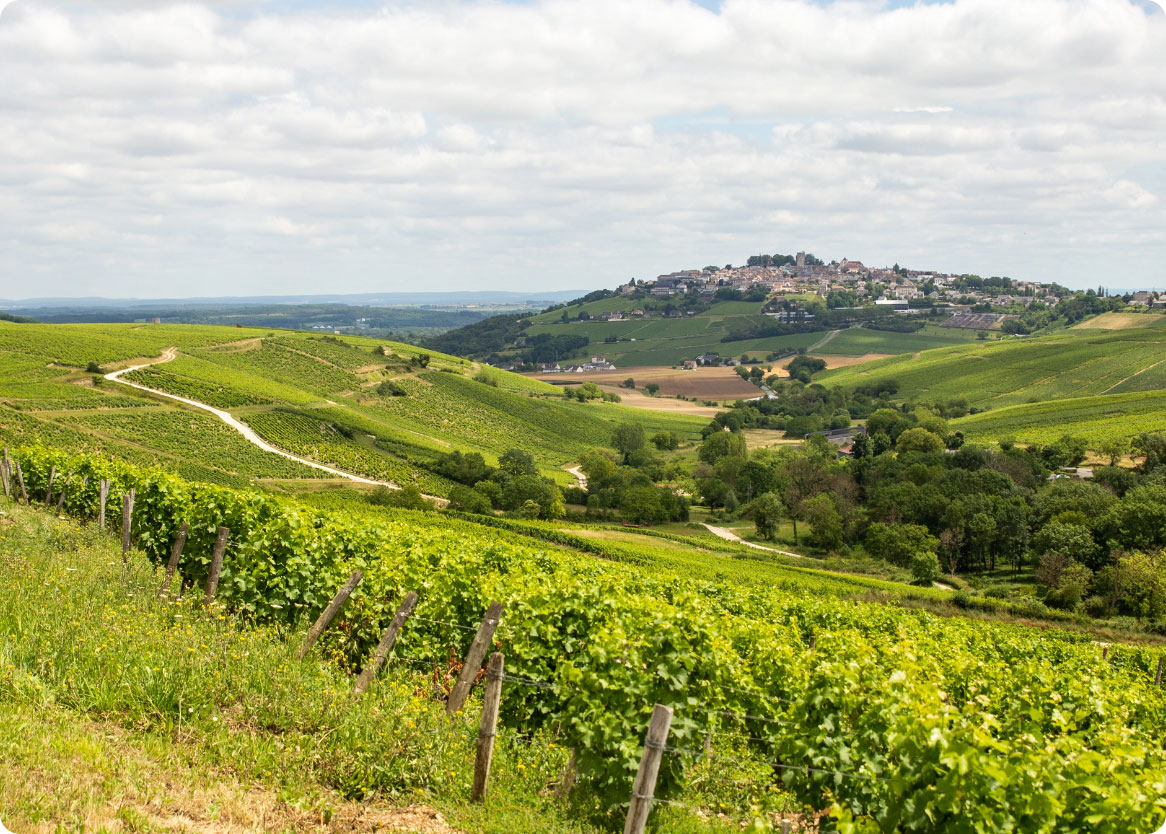
Ask a typical wine drinker what they know about the Loire Valley, and you’ll get a blank stare. But mention Sancerre, and their eyes will light up with recognition, while their mouths begin salivating like Pavlov’s dog. More serious wine collectors are a little better, and usually know a few of the best names in the region, but most cellars are conspicuously low on wines from the Loire in general. One reason may be the complexity. In the Loire you will find no simple right bank / left bank duality, no structured Village / 1er Cru / Grand Cru hierarchy. The sprawling Loire River travels over a thousand kilometers from the southeastern part of the Massif Central to its mouth at Saint-Nazaire, and the wine regions it passes along the way are as diverse as the distance suggests.
Here we will consider each of the major villages of the Loire from east to west. This is a region with innumerable small producers who deserve their vinous due, and indigenous grapes that we lack the space to mention. Readers who find pleasure in these wines should dig deeper. The producers below should be seen as essential, but insufficient for a full understanding of what the Loire represents: a first step into one of the great wine regions of France.
Sancerre and Pouilly
Separated by less than 10 kilometers as the Loire River nears the end of its northward journey before turning west towards the Atlantic, the villages of Pouilly and Sancerre are the best known to American collectors, so we will be brief. Didier Dagueneau is by far the most sought-after producer in Pouilly, with Didier’s son Louis-Benjamin helming the estate since his father’s tragic death in 2008. Ladoucette’s Baron de L is the other Pouilly wine that regularly fetches high prices – a rich, friendly style of Sauvignon Blanc that, while it comes in a stylish package, does not always age gracefully, particularly in warmer vintages.
Sancerre is home to more famous names than its sister village across the river. Edmond et Anne Vatan’s Clos La Néore is a tiny plot within Les Monts Damnés, which itself is possibly the top vineyard within Sancerre. It has become a challenging wine to source, and Anne and her husband Nady Foucault (of Clos Rougeard fame) have chosen to emphasize the vin de garde quality of their single bottling by switching exclusively to magnums from the 2018 vintage onward. Nearby, François Cotat fashions excellent wines from all three of Sancerre’s crown jewels: the aforementioned Les Monts Damnés, Cul de Beaujeu, and La Grande Côte. His brother Pascal Cotat makes similarly exceptional wines from the rest of the family parcels out of his garage in the village of Sancerre itself. Domaine Vacheron may be known for their red wines, but their single-vineyard Sauvignon Blancs should not be overlooked, while Gérard Boulay provides value and ageability in equal measure.
Vouvray and Montlouis-sur-Loire
Chenin Blanc is perhaps the most overlooked opportunity for white wine collectors in France, and the stylistic range is broad. While Vouvray was once synonymous with off-dry and sweet wines, dry styles which rival the best of Anjou are now far more available. François Chidaine is the king of Montlouis-sur-Loire, producing sec (dry), demi-sec (off-dry), and moelleux (sweet) wines with incredible acidity and length. In Vouvray, Domaine Huet has long been known for its single-vineyard sweet wines, which age with ease into their third, fourth, and fifth decades, but they’ve increasingly emphasized their dry wine program since American businessman Anthony Hwang bought a majority stake in 2005.
Though located far north of the river, the commune of Jasnières deserves a mention. Chenin lovers of the low-intervention persuasion should seek out producers like Eric Nicolas at Domaine de Bellivière, who are making a name for this previously unheard-of appellation.
Anjou and Saumur
Vouvray may still be the better-known appellation amongst the uninitiated, but dry Chenin Blanc reaches its pinnacle in Anjou and Saumur. Nicolas Joly’s La Coulée de Serrant in Savennières is perhaps the most famous, but can be mercurial, and there are many ambitious producers vying for its spot who offer more consistency. Thibaud Boudignon produces reductive, linear Chenin along the same stylistic lines as Joly, but far more dependably. Domaine du Closel’s Clos du Papillon is a benchmark for the region. Damien Laureau in Savennières and Thierry Germain (Domaine des Roches Neuves) in Saumur are making wonderful Chenin at even more affordable prices. Excellent, more heavily oaked examples are made by Domaine Guiberteau in Saumur and Eric Morgat in Savennières. The ultra-low-intervention producers Stéphane Bernaudeau and Richard Leroy should be mentioned, as the best bottles can be “Road to Damascus” moments for wine lovers, but their eye-watering price tags combined with their fragility in bottle can make them a gambler’s game.
Nantes
Given the size of its production and breadth of its distribution, Muscadet remains the most misunderstood white wine of the Loire. It has long been hampered by legally mandated high yields and a commercial image that was built on fresh but simple wines. The most dependable producers remain Domaine Luneau-Papin and Domaine de la Pépière, while Vignoble de l’Écu is gaining steam. Some interesting noises are being made by Domaines Landron, though they have yet to come to fruition.
We have barely scratched the surface of what the Loire Valley has to offer, and that’s just the white wines! Next week we’ll cover the red wines of the Loire, which are just as exciting from a quality perspective, and arguably even more overlooked by the collecting community. Trinch!