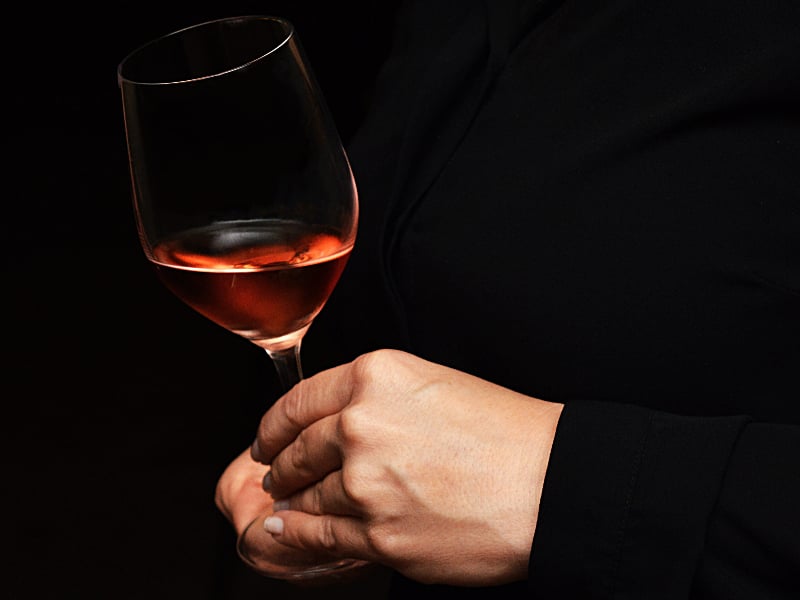
With the Master of Wine exam looming, I’ve been doing a lot of blind tasting, and not just of the classics. From South African Syrah to Moscatel de Setúbal, a lot can show up on the exam that isn’t part of the average wine lover’s rotation, prompting a broader revisit of the concept. Who should blind taste wine, and why? Should all wines be fair game, or only a narrow band of classics? Does blind tasting really tell us anything about quality, or is knowing what we are drinking an essential part of the wine experience?
The Professional Parlor Trick
To succeed in the typical blind tasting, one must identify the grape (or grapes), the region (with as much detail as possible), and vintage. This approach has the advantages of clear definition and palpable drama. It can be scored objectively and provides a proving ground for ambitious sommeliers to test their mettle. It can even be viewed as a spectator sport.
Unfortunately, it also misses much that is true about wine. For one thing, what about winemaking? Winemaking has more effect on a wine’s flavor than grape, region, or vintage. Yet it is such a personal variable, even within relatively small regions, that it defies simple quantification, undermining the parlor trick. To make things worse, this difficulty persists whether you widen or narrow your geographical lens. You might defend a Meursault call by noting the wine’s rich, creamy texture. But the truth is that within the village of Meursault there are very different approaches to richness, and few blind tasters would correctly note that, say, a reductive Roulot Charmes and friendly Jadot Charmes hail from the same village, let alone the same vineyard.
Widening the lens doesn’t help either. To continue with Chardonnay: reductive, mineral styles with serious concentration are now made in Oregon, Auckland, Patagonia, Perth, Sonoma, and Sussex – and that’s to say nothing of Hemel-en-Aarde or the Valle del Malleco. This problem is not new, and wine certification regimes have typically responded by narrowing the field of possible choices to “testable” regions and styles, even excluding certain producers within well-known regions that don’t fit the narrative of the accepted style.
Tasting for Technique
What makes better tasters, and ultimately better drinkers of wine, is a different approach to blind tasting: tasting for technique. Forget whether that Cabernet Sauvignon comes from Napa or Coonawarra. Does it have new oak? How much, and aged for how long? What about the alcohol? Is it a nervy 12.5% or knocking on the door of 15%? How long has that sparkling wine been aged on its lees? 9 months? 15? 60? These are the kinds of questions that take us beyond the regional guessing game and closer to what makes wine taste the way it does.
Once we’re finished thinking about technique, we can expand our consideration to non-winemaking influences. How warm might the climate be where this wine was made? What sort of grape has this much intense red fruit, or that strong a floral component? What combination of vine, climate, and pruning could achieve so much concentration? Once we start to identify these sorts of elements in a blind setting, we are much harder to fool when we are staring at an expensive label.
The Single Blind
Another far more useful blind tasting technique than the grape/region/vintage hat trick is the single blind. Anyone with an interest in wine can start to benefit from this kind of tasting almost immediately, but it is especially helpful for collectors, who usually feel comfortable within a few cherished regions. Take four or five of your favorite Nebbiolo producers (or another style/region of your choice) and have someone else pour them for you. You know which wines are in the lineup, and they are wines that you know well. Trying to correctly identify which is which quickly highlights the greatest gift of blind tasting: the removal of bias.
All of us walk around with mental pictures of producers and labels. So often when we think we are tasting objectively, we are actually projecting our memories and opinions about a certain wine onto the glass. Blind tasting neatly removes our ability to do so, and the revelations can be powerful. Maybe you’ve always thought of Vietti as modern and plush, but in the context of the flight it’s in the middle of the pack. Or perhaps you always thought of Krug as an oxidative expression of Champagne, but the flight reveals that Grande Cuvée seems to have become more reductive with recent releases. Even if your takeaway is “these Riojas all taste the same to me, and I love them all”, that insight can be invaluable for buying wine.
The Label Tax
Perhaps the most common critique of blind tasting is that knowing the context of what you are drinking is an inextricable part of the pleasure of drinking it. I think this sentiment is almost exactly true, but it lacks the proper conclusion. No one is advocating that you overhaul your entire cellar to obscure the labels, switching to a blind-only tasting schedule (that punishment is reserved for certification-minded professionals, like the 9th circle of Dante’s hell). It is rebuttal enough of this critique to say that blind tasting has a place – that it has something to teach us about ourselves and about the wines we drink.
Is it a cruel shame, though, to disabuse someone of a cherished hierarchy by blind tasting? Or to reveal that a favorite producer isn’t quite as exceptional as they thought? It might be. It seems almost a fair argument that some people like certain wines because… well, because they like them, whether that enjoyment comes from rarity, or a story, or an experience at the winery. And to strip all that away, some might say, does nothing to add to the enjoyment of wine. This paints the practice of blind tasting as a perilous tool, or Eve’s fateful bite of the apple.
Fair as the context critique may be, I am convinced that for most serious wine enthusiasts, a sprinkle of blind tasting here and there is like a pinch of salt in the kitchen. It may not be very filling on its own, but it works wonders to punch things up when used in the correct proportion. At minimum, the practice reminds us to pay close attention, and to make sure we’re tasting what’s really in the glass rather than what’s in our heads.
So then, who should blind taste? If you’ve made it this far, it’s a good bet the answer is you. Which wines are fair game? All wines, if the object is learning, not winning. And does blind tasting really tell us anything about quality? Who knows? But so long as it teaches us something about our own taste, does it really matter?