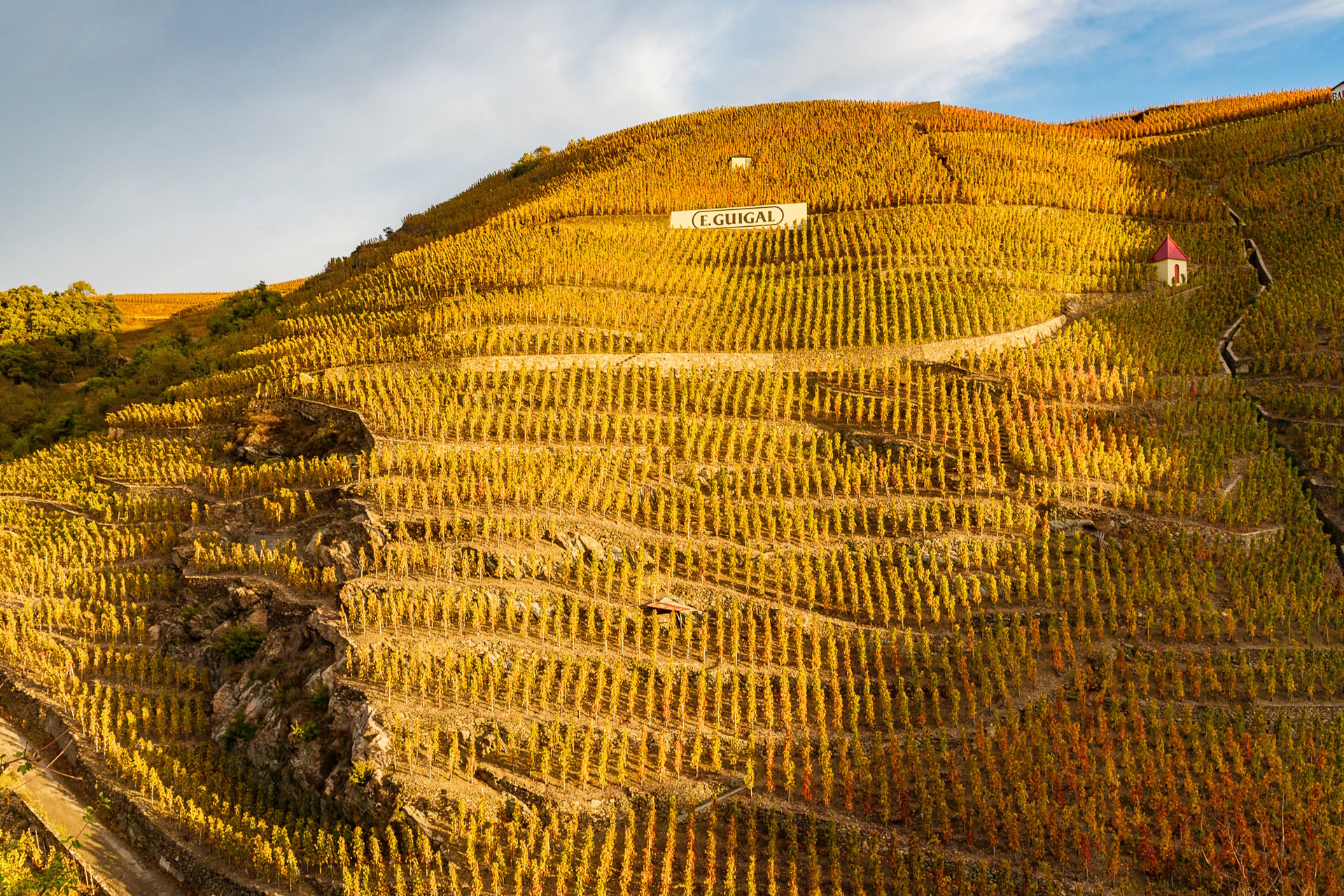
In my 2025 in Review article back in December, I mentioned Côte-Rôtie as a region to watch for value in top-tier red wine. While the market for Rhône wines has remained flat since that time (there has been less than a 1% change in the Liv-Ex Rhône 100 Index), the failure of others to realize the opportunities in the Rhône Valley, particularly in the Northern Rhône, just means there are incredible buying opportunities for you, the savvy collector.
We typically think of the Rhône Valley as split neatly in two, with Syrah and the occasional Viognier, Roussanne, or Marsanne up north and a wide array of Grenache-dominated blends to the south, each contributing roughly half of production. In reality, this view is wildly skewed, as the Southern Rhône produces over 90% of the region’s total wine output. In 2024, just 8% of Rhône wine was produced in the Northern Rhône, including the small swaths of Côtes du Rhône not found in the south, regional IGPs, and all the AOCs put together.
The reasons for the Northern Rhône’s smaller production levels are myriad, including historical factors like the loss of life in the two World Wars of the 20th century, and the attendant loss of vineyard know-how. These days, the increased labor and viticultural costs associated with steep, often terraced slopes and the cooler, more varied temperatures this far from the Mediterranean (Côte-Rôtie is as close to Dijon as it is to the southern coast of France) mean that each cluster of grapes is more difficult and more expensive to cultivate than in the galet-covered vineyards further south. That said, higher auction prices for Northern Rhône wines compared with their southern counterparts (excluding the high-flying Château Rayas in Châteauneuf-du-Pape) have incentivized ambitious growers and producers to reclaim forgotten vineyards like Clos Florentin in Saint-Joseph, making it a more exciting time than ever to drink Rhône Syrah, Roussanne, and Marsanne (ok, maybe even Viognier).
Today we’re taking a virtual walk through the Northern Rhône from north to south, surveying the major appellations and their defining and up-and-coming producers.
Côte-Rôtie
The largest of the small Syrah AOCs of the Northern Rhône (a little more than twice the hectarage of Cornas and two and a half times that of Hermitage), Côte-Rôtie owes most of its notoriety in the modern era to the Guigal family. Starting with La Mouline (1966), then La Landonne (1978) and La Turque (1985) and now joined by La Reynarde (2022), Guigal’s focus on single-vineyard expressions captivated the wine collecting world and its “La-Las” continue to notch top auction prices. Only red wine is permitted here, with up to 20% Viognier co-fermented with Syrah. In practice the Viognier rarely cracks 10%, and many producers choose not to include it at all. Viognier’s color-fixing and aromatic character are still of interest to many producers, but in the era of climate change, its main draw – the fact that it ripens a week to two weeks earlier than Syrah and can cover for underripeness in a difficult vintage – is mostly passé.
The La-Las are still in high demand, but they no longer stand head and shoulders above the competition. These days Rostaing’s Côte Brune, Gangloff’s Sereine, and the wines of Domaine Jamet, among others, have risen to command similar prices. Look out for top producers in vintages like 2019, 2016, and 2010.
Château-Grillet
One of France’s rare single-producer AOCs (the famous Grand Cru monopoles of the Côte d’Or and Coulée de Serrant in the Loire are other examples), Grillet was purchased by French billionaire François Pinault in 2011. Extensive replanting, revitalization, and renovation ensued, and the general feeling in the trade is that the wines have markedly improved over the intervening 15 years.
Unlike the Viognier wines of Condrieu just to the south, Grillet tends to fare much better with bottle age. That is not to say these wines should be held with abandon, but they can usually develop handsomely over a decade or so. Look for the excellent 2019 vintage.
Condrieu
Heading south along the west bank of the Rhône river, one would be forgiven for thinking nothing had changed from Côte-Rôtie. The same échalas stakes and dramatic, terraced hillsides meet the eye, but a keen eye at harvest time would reveal that, far from the deeply colored Syrah just to the north, the small appellation of Condrieu only permits white wines made from 100% Viognier.
Though the appellation still allows a sweet version, modern Condrieu is dry, often with a kiss of new oak, though percentages have been declining. Condrieu has suffered downright abuse from the sommelier set in recent decades, with complaints of flabby, short-lived wines without the class to match their price tags. Many examples, no doubt, deserve this derision, but excellent examples can still be found – Georges Vernay’s legendary Coteau de Vernon, for example, where coarse sand covers a deep bedrock of granite, giving a precision and drive rarely found in the other Condrieu bottlings.
Saint-Joseph
Saint-Joseph is about 25% smaller than Crozes-Hermitage in terms of planted area, but more than twice the geographic length from north to south, snaking along the west bank of the Rhône from the southern end of Condrieu to the outskirts of Valence. It’s easy to think of those two, Saint-Joseph and Crozes-Hermitage, as the “big” Syrah appellations of the Northern Rhône, but “big” hardly covers it. Saint-Joseph turned out more than 13 times the volume of wine produced in Hermitage in 2024, and “Syrah” isn’t quite right either – 14% of that production was white wine made from Marsanne, Roussanne, or a blend of the two.
Like so many appellations around Europe, Saint-Joseph was expanded in the middle of the 20th century (1969, in this case), adding many communes that arguably didn’t deserve to share the same name as the top sites. The best parcels have always been situated just across the river from Hermitage around the towns of Tournon-sur-Rhône and Mauves, where the best wines are still made today. The two undisputed champions of the region are Jean-Louis Chave, whose Saint-Joseph Clos Florentin can be as compelling as his famed Hermitage Rouge, and Pierre Gonon, whose Saint-Joseph Vieilles Vignes (from vines previously owned by Raymond Trollat and planted in 1920) commands astronomical prices. For our money, the regular AOC Saint-Joseph is the one to stock.
Crozes-Hermitage
The largest AOC in the Northern Rhône by both planted area and vinous output, Crozes-Hermitage’s quality is varied, due in part to the extent to which its soils differ from both Hermitage, on whose name it sought to trade, and the other Syrah-based AOCs of the Northern Rhône. From the schist of the Côte Brune to the granite that dominates the other top AOCs, very little clay can be found. But in Crozes-Hermitage, outside of a few pockets, red clay abounds, and the resulting wines tend to show less depth and complexity than their more illustrious neighbors.
Nonetheless, ambitious wines can be found bearing the Crozes-Hermitage name, including Natacha Chave’s Domaine Aléofane and Alain Graillot’s “La Guiraude”. The finest vintages of these wines can easily stretch into their second decade but still pale in comparison to the greats of Hermitage itself.
Hermitage
Hermitage is undoubtedly the best-known Northern Rhône appellation, despite being the smallest dedicated to red wine. The most important Syrah vineyards on this legendary hill are on its western flank, which shares more geologically with the west bank of the river and the granitic Massif Central (among these Les Bessards and Le Méal). Hermitage is also the most egalitarian Northern Rhône Cru in its production, dedicating nearly a third of volume to white wine (again, made from Marsanne, Roussanne, or both).
Hermitage’s limited vineyard land is dominated by a few, well-recognized producers. Jean-Louis Chave is certainly the most lauded, whose red and white versions of Hermitage age well (though in my experience, the whites not as well as some pundits claim). Chapoutier’s striking l’Ermite Blanc and Guigal’s “Ex-Voto” bottlings of both colors (from vines acquired from the legendary Jean-Louis Grippat in 2001) can be excellent when showing well, but seeking out the rarer offerings of smaller operations can also be rewarding. For instance, check out Bernard Faurie’s single-vineyard Le Méal (not to be confused with Lionel Faury, whose Saint-Joseph wines may be known to readers).
Cornas
Often labeled “rustic” by lazy wine writers, Cornas is more varied than that pejorative implies, despite its mere 164 hectares. There is very little that can be called “rustic” about Thierry Allemand’s Reynard or Chaillot. And while, yes, Clape’s famous Cornas assemblage (like Bartolo Mascarello in Barolo, Clape eschews single-parcel wines in favor of a single, blended grand vin) can be earthy and wild, it is no more so than, say, Jamet in Côte-Rôtie.
Franck Balthazar and Alain Voge are the two other names to know in Cornas, the former a traditionalist whose wines ooze earth and spice, and the latter a producer of more modern examples, another counterpoint to the oft-cited “rusticity”. Though nearly impossible to find outside of the auction houses these days, Marcel Juge’s Cornas should be purchased on sight if one’s means allow – his wines (and those made by his daughter Olga until 2015) should be mentioned in the same breath as Gentaz (whose vineyards are now owned by Rostaing) or Trollat.
Saint-Péray
Even smaller than Hermitage, this tiny appellation south of Cornas is dedicated to white wine (once again the familiar Marsanne/Roussanne duo), plus a little traditional method sparkling that is delicious, if not as grand as the best of Champagne. Its greatest practitioner is probably A. Clape of Cornas fame, whose bottling tends to be around 80% Marsanne (the appellation itself shares a similar proportion, with 77% Marsanne and 23% Roussanne planted).
In Conclusion
We should technically include a section on Diois (Clairette de Die, Crémant de Die, Châtillon-en-Diois, etc.), but as those wines rarely feature on the US import market and are stylistically disparate from the regions listed above, their charms will have to wait for another occasion.
Drinking away from the limelight is always a solid option for maximizing the quality of one’s cellar while minimizing cost (speaking relatively, of course). There is arguably no better region in France than the Northern Rhône for drinking world-class wine that has missed the meteoric price inflation of Burgundy or Champagne. Some of the benchmark producers of the Northern Rhône can still be had for the same price as a middling producer of Gevrey-Chambertin, and will undoubtedly provide not only more immediate drinking pleasure, but also more longevity in the cellar.