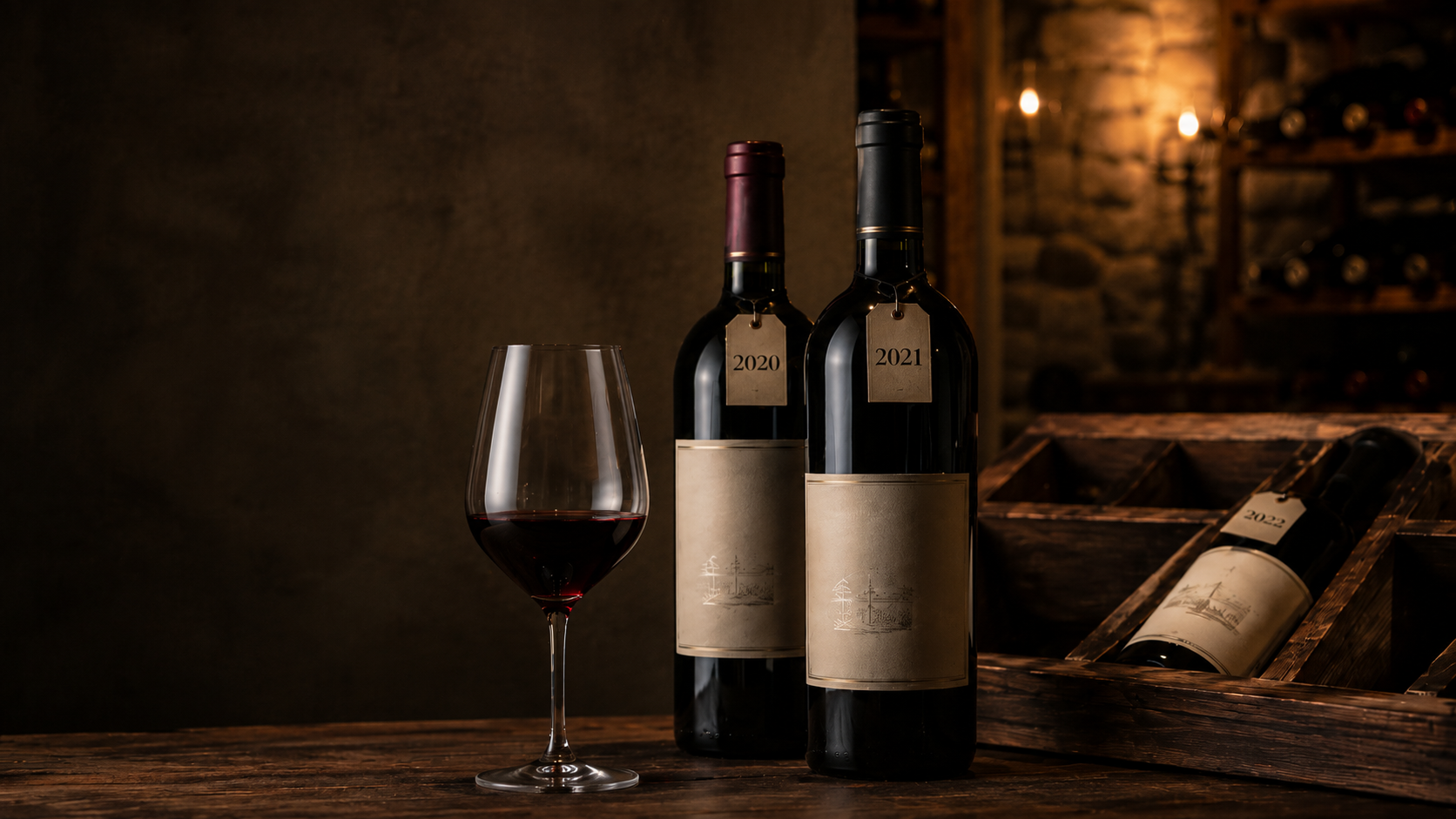
The jury is still out on the 2026 vintage. Whether the widespread wildfires near Bordeaux will affect the quality of the vintage remains to be seen, while record-early harvests are underway across parts of the Northern Hemisphere. But today we’re taking a look at the completed vintages of the 2020s, searching for the best birth-year bottles to stock for 2020s babies ahead of their 21st birthdays. When buying birth-year bottles this early in the game, there are a few overarching themes to consider:
- Begin with the end in mind. When buying this far ahead, it is essential to have a clear picture of your goal. Are these wines going to be enjoyed exclusively after the child turns 21, or will you open some along the way? Far more wines will improve for ten or fifteen years than will truly benefit from 21 to 30 years of cellar slumber, which leads to our second point:
- Twenty-one years is a long time for wine. This year, the 2005 vintage turns 21, and while it’s a bit unfair to judge the general concept of birth-year wines on such a legendary vintage, even in 2005 careful buying was still necessary. All but the best white Burgundy, for instance, is beginning to show its age. The same is true of dry Riesling. Keller GGs are still holding their own, but many lesser examples are showing distinctly oxidized fruit. Sure, Bordeaux wines of even reasonable quality are still developing admirably, but that has a lot to do with 2005 itself. A person born in 2007 won’t be able to say as much.
- Remember what you were drinking at 21. This is the point most often forgotten by birth-year cellar stockers. You may have immaculate taste now, but I know I wasn’t drinking Burgundy or Barolo at 21. If you want to actually share the wines you’re buying with your child or godchild, it’s worth thinking about what your palate was like when you reached drinking age. Structure-loving 21-year-olds probably exist, but the odds of luring the average 21-year-old into wine are much better with a Spätlese Riesling than a sandpaper Sagrantino.
With those out of the way, let’s get into the best cellar buys from the 2020s.
2020
Champagne’s exceptionally high pH does not bode well for its longevity in this warm vintage, and as much as I ceaselessly recommend 2020 white Burgundy, its extreme friendliness at this stage does not necessarily suggest it is built for the long haul, despite good acidity (plus it would be a shame to miss out on drinking it over the next five years). Chardonnay enthusiasts could also dabble in Margaret River Chardonnay (probably the best vintage since 2013), but again, a 20-plus-year timeline is a little worrying. German Riesling performed wonderfully, particularly in the Mosel and Nahe, and will have no trouble going the distance.
For red wine, one must hope one’s child or godchild will be a fan of the classics (if not, there’s always time to write them out of the will). Red Bordeaux (particularly the left bank and Pessac-Léognan), red Burgundy, and Piedmont had excellent vintages for long-term aging. Among these, I expect the best wines of the Médoc and Barolo to be the longest-lived, and therefore likely best suited for a birth-year cellar.
2021
Despite challenging conditions in much of Europe, 2021 offers a wide range of styles for long-term cellaring. The best whites hail from Austria, though only the most exceptional examples should be kept for more than 20 years (except, of course, sweet and botrytized styles, which will handle that time easily). Reds were particularly excellent across Italy, where Piedmont, Tuscany, and Etna produced concentrated, age-worthy wines. Lovers of New World reds will find plenty to appreciate in northern California, Oregon, and Australia (just stay out of Western Australia, which didn’t fare so well).
2022
Though not quite so exuberant in their youth, 2022’s white Burgundies are excellent and may prove longer-lived than their 2020 brethren. But French white wine enthusiasts should focus most of their attention on the Loire, where dry, off-dry, and sweet styles were made with excellent concentration and acidity, making them perfect for the cellar! Botrytized styles from Austria are also well worth stockpiling.
France outshone Italy and Spain for long-term reds in this vintage, with Bordeaux (especially the right bank), Burgundy, the Loire, and the Southern Rhône producing exciting wines with hints of future greatness. Of these, the Loire Valley wines are particularly noteworthy.
2023
It’s hard to judge the best Champagnes this early (they won’t be released for years), but the Chardonnay harvest in 2023 was promising for Blanc de Blancs styles. German Riesling was extremely successful across more or less every region, and the sweet wines of Sauternes and Barsac are legendary.
Red wines did admirably in many classic regions: northern California producers whispered of the “vintage of a lifetime,” the Loire posted another fantastic vintage (not so much for Chenin, but excellent for Cabernet Franc), and both Piedmont and Bolgheri produced cellar stunners. Red Bordeaux wines generally lack the concentration of 2022, but their more balanced alcohols may carry the best of them well into their 20s. If care is taken, there were some exciting Syrahs made in the Northern Rhône, particularly among the fresher and more structured producers. The richer examples are less likely to hold on as long as we need for this purpose.
2024
Though the quantities are low in the Mosel and Nahe, the more northern Rieslings in Germany are of promising quality for long-term aging in 2024, which is more than you can say of most other classic white wine regions in this rather challenging vintage. For reds, the Iberian Peninsula is the standout, with Rioja and Ribera del Duero producing excellent dry reds and the first generally declared Port vintage since 2017.
2025
Again, Germany posted good results for its white wines in 2025, making German whites the decade’s most consistent performers so far (Germany’s marginal climates have, so far, benefited more directly from recent warming trends). The top South African whites are also of tantalizing quality and may prove long-lived.
We’re still a long way from the release of most top 2025 reds, and judging them now is ambitious and possibly foolhardy. Still, producers in both northern California and Bordeaux are optimistic about the vintage’s potential concentration and longevity, which may bode well for 2025 babies.
Patience Is a Virtue, but Tasting Is Essential
The prattling of wine experts online is all well and good, but even the best-laid plans go awry, and aging wine is an irregular business. As such, whichever vintage you are investing in, the best policy is to buy enough of each wine to pull a bottle from time to time and check its development. Nothing is more devastating than saving an unbroken case of top-flight Burgundy for 25 years, only to find it has all turned to vinegar when you open the first bottle. Besides, it’s just more fun to enjoy a little along the way!