US collectors have long viewed English sparkling wine with a skeptical eye, and for a good while it was largely due to the price. I remember buying wine for a distributor a decade ago and being offered English sparkling as an emerging style, frothing with potential (pun, sadly, intended). The non-vintage wines were a bit on the sweet side (ostensibly to balance the high acidity of England’s cooler climate, but overdone nonetheless), but the vintage bottlings were balanced and full of character. The only catch was the price tag: they cost the same as solid grower Champagne. In the intervening ten years, two major changes have occurred. The quality of English sparkling wines has steadily increased. Meanwhile, no thanks to a massive surge in pricing during the early pandemic years, the price of many top Champagnes has roughly doubled.
Like gin, English fizz has been “about to be the next big thing” for going on 15 years at this point. Is it finally time for the US market to give the category a serious look?
The Tepid War
In a 2015 article published in the UK wine magazine Noble Rot, Ian Kellett of Hambledon Vineyard in Hampshire made a bold prediction about how the relative global standing of English fizz and Champagne would change over the ensuing decade: “…within ten years [English sparkling wine] is going to be all over the front pages of the newspapers. There’s going to be a war. They’re going to be livid.” The “they” to whom he was referring was, of course, the Champenois. In the UK market, Kellett’s prediction has proven somewhat true, if nowhere near as dramatically as his wording suggests. From 2021 to 2025, the market for Champagne in the UK declined, while English sparkling wine continued to post strong growth. The UK, once Champagne’s largest export market by volume, trailed the US by about 3.7 million bottles in 2025.
While those numbers seem to suggest runaway success for English sparkling wine, the reality is more measured. Great Britain now has about 4,841 hectares under vine, up sharply in recent years, but that number is still tiny overall. To put it into perspective, Champagne has about 34,200 hectares under vine, and the state of California has well over 175,000. If English fizz is going to make a dent in the global sparkling wine market, it clearly needs more supply, but it also has a marketing challenge ahead of it. Champagne enjoys a collective marketing machine that English wine cannot realistically match. To raise the image of English bubbly outside the domestic market – exports accounted for just 9% of English and Welsh wine sales in 2024 – it’s going to take some clever marketing, because outspending Champagne simply isn’t feasible.
Rapid Evolution, Slow Progress
It wasn’t that long ago when winemaking was seen as a fringe hobby in England. A frigid climate (most English vineyards are between the 51st and 53rd parallels, above the 50th-parallel “outer limit” for viticulture that was taught as gospel among the wine trade for decades) led to the planting of cold-hardy hybrids like Seyval Blanc, a more functional than ambitious variety. The first breakthrough, and likely a major reason why sparkling wine is still such a large part of the English wine identity today, was the rise of Nyetimber in the 1990s, proving that sparkling wine of surprising quality could be made from Chardonnay, Pinot Noir, and Meunier grown in the south of England. But a decade later, in 2004, Seyval Blanc, Reichensteiner, Müller-Thurgau, and Bacchus still topped the list of most-planted grape varieties.
In the later 2000s, things began to take off. Vineyard area grew 148% from 2004 to 2013, then expanded dramatically again over the following decade, supported by a mix of domestic expansion and international capital and expertise, from Dutch ownership at Nyetimber and German ownership at Bolney to South African involvement at Gusbourne and Leonardslee, alongside French Champagne investment led most visibly by Domaine Evremond. Today, Chardonnay, Pinot Noir, and Pinot Meunier dwarf the vineyard land dedicated to the hybrids of the past. And though the UK’s wine image is undeniably tied to sparkling wine, still wine is also making significant strides.
What’s in a Name?
Wine enthusiasts know most of the major wine regions in France, Italy, and Spain like the back of their hand, and many can even wax eloquent on the differences between the Côte des Blancs and Montagne de Reims, or Gevrey-Chambertin and Chambolle-Musigny. But ask about the finer geographical points of English sparkling wine and you’ll likely be met with a blank stare. Part of this is the recency of the rise of the style, and part is English fizz’s still-nascent global presence, but two other challenges face English producers: wine-origin law and the lack of a strong name.
First, there’s the issue of PDO law. Until the end of the Brexit transition period on December 31, 2020, Great Britain remained within the EU geographical indication framework. From January 1, 2021, the UK introduced its own GI schemes for wine and other protected products. Apart from the odd, single-vineyard, 100% Bacchus Darnibole PDO, originally registered with the EU in 2017, and the more reasonable Sussex PDO, registered in 2022, there has been little innovation in the delimiting and branding of UK viticultural areas outside the broader English and Welsh PDOs.
The second challenge is what to call the category. “English sparkling wine” is a mouthful, and “English fizz” is too flippant (and frankly, too British) for the global market. Various campaigns for a more creative name have mostly fizzled. “Merret” was tried by a group of producers, and “Britagne” was attempted, but so far, no mononym with sufficient stickiness has been found, ceding a monumental marketing advantage to the direct and commanding “Champagne.”
Producers to Watch
All of the above paints a clear picture of opportunity for the curious collector: a region with serious investment, where quality has skyrocketed, but where the economics limit the marketing spend needed to significantly increase demand and, in turn, prices. Which leaves only one question: Which producers should you buy? Here is a nonexhaustive list:
Domaine Evremond – Founded in 2015 by Champagne Taittinger and UK partner Hatch Mansfield, Domaine Evremond now has two excellent non-vintage offerings on the market: Classic Cuvée Edition I, built around the 2020 harvest, and Edition II, built around the 2021 harvest.
Hambledon Vineyard – Established way back in 1952 and the self-proclaimed “Birthplace of English Wine,” this historic vineyard was revived under Ian Kellett around the turn of the millennium. The Classic Cuvée is perhaps the best value in English sparkling, and while the step-up Première Cuvée is excellent as well, it’s a bit hard to justify the jump in price when the Classic is so delicious.
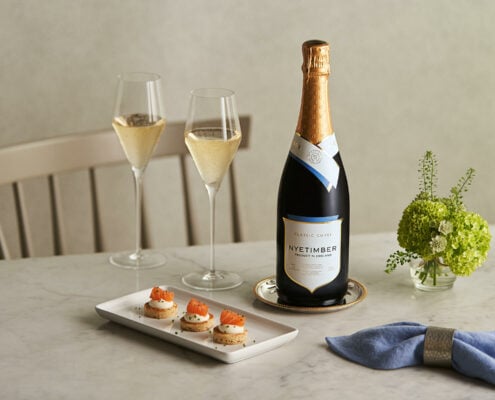
Nyetimber – The “OG” sparkling producer in the South Downs is still making phenomenal wine, even more so since Dutch-born Eric Heerema acquired the estate and recruited the husband-and-wife team Cherie Spriggs and Brad Greatrix. Widely distributed but no worse for it, Tillington Single Vineyard and the prestige cuvée 1086 by Nyetimber are well worth tracking down.
Sugrue – Irishman Dermot Sugrue started as a brewer, then completed vintages in Bordeaux, including at L’Eglise-Clinet, before joining Nyetimber as assistant winemaker and soon becoming head winemaker. He left Nyetimber in 2006 and went on to help establish the wine program at Wiston Estate, while simultaneously establishing his own vineyard at Storrington Priory at the foot of the South Downs in West Sussex. Since the initial 2009 vintage release, these wines have been firmly established as insider favorites.
Wiston Estate – South African-born Pip Goring waited more than three decades to establish a vineyard at Wiston Estate. When her son Richard returned to the estate in 2006 and Dermot Sugrue joined the winemaking effort soon afterward, the time had finally come. The vintage wines from this estate are especially worth seeking out, as are the Library Collection releases of Blanc de Blancs.